If you train on a consistent basis, chances are you’ve encountered some sort of tendon/ligament strain, sprain, or tear. Whether you’re a runner who struggles with Achilles pain, or a powerlifter dealing with tricep tendinopathy, connective tissue injuries can be frustrating, confusing, and challenging to rehab.
Outside of traditional soft-tissue therapy, rehabilitative exercise, and nutritional approaches, what else can we utilize to speed the body’s healing capabilities?
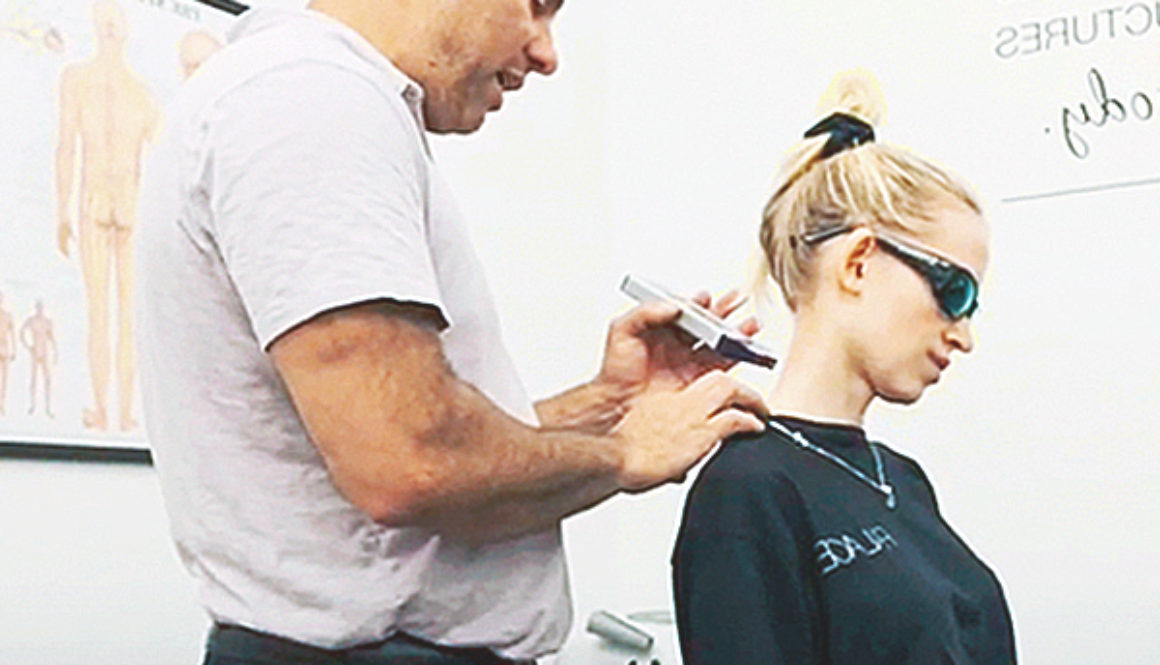
Laser therapy is an effective supplemental treatment to add to your plan of care. Utilizing light waves, research has demonstrated laser therapy can;
Stimulate ATP production – Increased energy supply within a cell to support healing of tissue
Increased circulation through vasodilation – Enhances delivery of oxygen and immune cells to healing tissue
Improve cellular maintenance by stimulating several “clean-up†and healing processes;
Phagocytosis – Ingestion of pathogens, bacteria, cellular debris
In layman’s terms, research shows that laser therapy can act to support and enhance the body’s natural healing processes, leading to shorter periods of recovery from injury or chronic pain. Ask your Helix provider whether laser therapy might be appropriate for you!
The word ‘electrolyte’ is thrown around liberally in the world of sports performance and nutritional supplementation, but what in fact are electrolytes and how do they affect our ability to move, compete, and enjoy the great outdoors?
Electrolytes are minerals that in solution form have the capability to conduct electricity. Their presence in the human body, via consumption of food and drink, facilitates the contraction and relaxation of muscle fibers through the nervous system. Athletes that excessively sweat due to prolonged physical activity (over 90 minutes) are suggested to supplement with electrolytes. Other circumstances necessitating supplementation may include multiple games/events within a short time span (tournaments), excessively hot/humid, or fluid loss due to fever, vomiting, or diarrhea.Â
The most common electrolytes found in sports nutritional supplementation are Sodium, Potassium, Magnesium and Calcium, ensuring these four minerals are balanced is a great starting point for increasing performance in the gym, pool, or on the field!Â
Magnesium – Can help to promote muscle relaxation and reduce cramping.Â
Sources: green leafy vegetables, nuts, beans, whole-grain cereals.Â
Deficiency (hyponatremia): nausea, headache, confusion and fatigue
Sports drinks are marketed as a source of electrolytes, but generally come with a staggeringly high level of sugar (one 32 oz Gatorade contains ~53 grams of sugar!). Try this homemade sports drink for an electrolyte boost without the sugar crash!
Home Sports Drink Recipe
¼ tsp. salt
¼ cup lemon juice
¼ cup honey
1 ½ cups unsweetened coconut water
2 cups cold water
Option: Powdered magnesium or calcium (based on bloodwork and recommendation from a medical doctor)
16-24 ounces per pound of bodyweight lost due to fluid loss
Â
Â
Thomas Howes Athletic Development Coach & Senior Rehabilitation Specialist
Here are 3 dynamic exercises to get you prepared for your next run
The first exercise, 90/90 Hip Translations, work on warming up your hip capsule and the muscles that innervate your low back, pelvis, and knees. This is an important yet gentle step to increase the range of motion and control from your hips. The majority of your stride with come from this control and full range of motion. It will also help to decrease the likelihood of injuries from compensation patterns.
The next exercise, Dynamic Runner Prep, helps to activate your posterior chain. This gets the muscles of the glutes, hamstrings, calves and more to fire. This will help to control and use the proper muscles needed during running. If they don’t fire we can compensate with improper muscles like your low back (erectors and quadratus lumborum), quads, and hip flexors. If we use these instead you can expect to experience low back pain, side cramps, hip flexor cramping, knee pain, IT-Band tightness, shin splints and more. So get that posterior chain firing!
Lastly, the Dynamic Runner will warm up your balance and proprioception. During running you’re rarely standing still. The tiny muscles and nerves that help us stay up-right and propel forward need to work in conjunction with the big muscles that help us power into the next stride. By imprinting the proper motion of loading and exploding replicates your running pattern. By doing this before your run it’s easy to see and CORRECT what imperfections are there. Plus, it gets your brain and body ready to know how it should feel to be running with correct form.
Try these before you next run and let us know how you feel. Keep running!
If you ever have any questions or something doesn’t feel right, please reach out to your rehab specialist or provider. And don’t forget, you can always schedule an in-depth appointment to look at the foundations of your stride and how your running gait patterns could be causing you pain. We’re here to help!
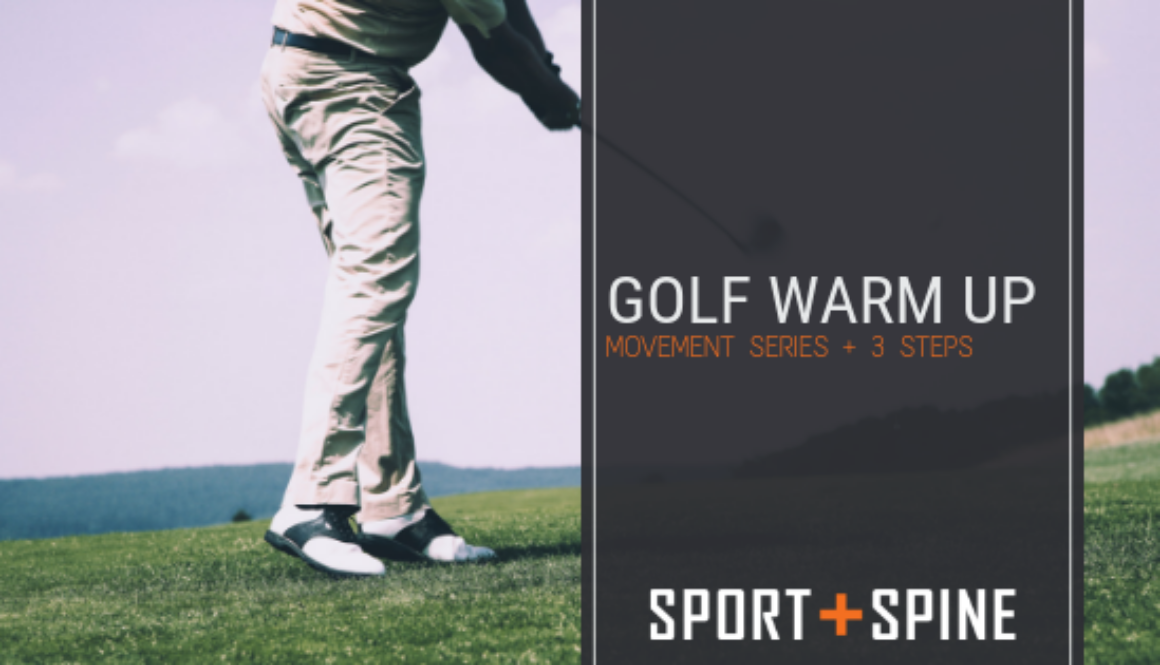
Here are 3 dynamic exercises to get you prepared for a round of golf.
The first exercise, Hip Hinge with Dowel works on warming up for the full-body movements required for a swing. It fires the posterior chain and provides tactile feedback for a proper set up. If you want to protect your low back this is the key to a safe but effective swing.
The next exercise, Hinge to Rotation works on thoracic rotation and core activation. Both vital parts of a powerful stroke that takes pressure off of your low back. This not only warms up for your swing, but it increases your range so you can load the eccentric portion of the movement. Basically, think about loading a slingshot: the further you pull back, the harder it shoots. This rotation helps you stretch your upper back and (most importantly) load your CORE so that you can generate that power.
Lastly, the overhead press will warm up your shoulders and upper back, putting you into a perfect posture.
Try these before you next 18 holes and let us know how you feel. Keep swinging!
If you ever have any questions or something doesn’t feel right, please reach out to your rehab specialist or provider. And don’t forget, you can always schedule an in-depth appointment to look at the foundations of your game and how your swing could be causing you pain. We’re here to help!
“Beach Body! 500 Crunches per Day! Killer Core!â€
During the spring season when clothing departments are readying their summer collection, most advertisements remind you that the beach season is fast approaching. Everyone needs those ‘chiseled’ abs and bikini bodies to feel confident when at the beach. Many exercise companies feature their programs using similar methods. They tell you that you ‘only’ need to do a simple 500 crunches per day to get the results you’re looking for. All of the emphasis is on the abs. But in all of the advertisements and superficial marketing, who ever talks about the importance of the core? It is more than just a part of one’s body you should show off if you’re lucky enough to have the genetics, diet, and consistent exercise routines to develop that coveted six-pack.
Importance of Core Strength
What exactly is the core? Is it that part of your body that can make your stomach look flat? That certainly plays a part, but it is not only composed of your abdominal muscles. It includes the back and pelvic floor muscles as well. The core aids in the support and protection of all the body parts connected to the spine. Ultimately this determines and enables good posture. Along with protecting the spinal cord, the core protects vital inner organ and important areas of the nervous and circulatory systems. Additionally, the body’s center of gravity lies within the abdomen. Therefore strength in this area can dramatically improve balance. Abdominal strength can dramatically decrease back pain. Through the plasticity and compensatory elements of our body, force us to rely more on our back muscles, overworking them. This increases the chance of injury.
How to Strengthen Your Core
There are various trunk stability and tests as well as common and simple strengthening exercises. These include crunches, planks, side planks, push ups, deadlifts, and knees to chest while hanging from a bar. Many people get bored with planks and crunches, however. If that is the case for you, other core bodyweight exercises are a fun option! Ask your chiropractor for new and interesting ways to challenge your work out.
Here is a GREAT and surprisingly challenging core exercise demonstrated by Andrew and Rose
Still hungry for more? Follow us on Facebook or Instagram. Better yet, come into one of our clinics to learn even more!
Have you ever been interested in pursuing yoga or Pilates, or maybe both? Or perhaps you already use one or the other (or both) as a form of exercise, but would still like to learn why they are beneficial forms of physical activity, and what their specific benefits are. Read more to find out!
The Beginning
The practice of yoga originated in India over 5,000 years ago. It has become an important part of their culture, and many different types of yoga have stemmed from the original practices.
Pilates is a much more recent form of exercise, started by Joseph Pilates, a German athlete, in the mid 1900’s. It was created as a form of rehabilitation and used to strengthen patients, both injured and healthy. Quickly it became very popular within the dance community as it aided and strengthened their training and performance.
Mind, Body and Spirit
While Yoga really seeks to integrate the mind, body, and spirit, Pilates focuses more on mind and body. Joseph Pilates practiced yoga himself, and this practice strongly influenced the creation of his form of strengthening. However, if you’re looking to include a spiritual experience to your practice, Pilates typically will not satisfy that. Exploring and studying spirituality within oneself through mediation is a very important part of yoga.
Breathing Techniques
Though efficient breathing is essential in both practices, yoga places a special emphasis on the breath, trying to match deep breathing to each movement and posture while inhaling and exhaling through the nose.
Pilates focuses on breathing as a way to bring energy to your working muscles, inhaling through the nose and exhaling out of the mouth.
Strength and Flexibility
While both yoga and Pilates will aid in strength gains and increased flexibility, yoga emphasizes balance, and will work out every muscle equally. Each posture is countered by another posture, ensuring muscle and body balance. Yoga aids in healing, flexibility, and joint strength, while striving to achieve mental, spiritual, and physical well-being.
Pilates places great emphasis on core and spine strength. Some classes use machines to facilitate strength gains, while other classes simply use the body’s weight and resistance to increase strength.
Class Structure
Yoga classes are set up by the style chosen, such as Bikram, Kripalu, Ashtanga, or Vinyasa, and each style includes different poses. Mediation exercises or some type of focus is often given at the beginning and end of a yoga class.
Pilates classes are more structured, and focus on strengthening the core of the body and the spine. The series of exercises or routines are fairly consistent, and you can often know what to expect at the beginning of a Pilates class.
What’s Best For Me?
Whether you chose yoga, with its emphasis on deep breath, balance, and spirituality. Or Pilates, with a more structured routine and a focus on strengthening, (or both!) you now have the information necessary to decide, or simply to appreciate why you have chosen one of those practices already!
Check out Anya’s post on what to expect for your first HOT YOGA class to be posted soon. She will also be writing soon about yoga mat reviews. Subscribe and Follow us so you don’t miss out!
If you’re in the Seattle or East-Side Area check out some of our favorite studios we practice at!!
Have you or someone you know ever experience low back pain? Chances are, you’ve responded ‘yes.’ Low back pain is one of the most common forms of musculoskeletal degeneration. According to the National Institute of Health, lower back pain is the most common cause of work-related disabilities. It is also a leading contributor to missed workdays. Approximately 80% of all adults have experienced low back pain in their lives.
What causes low back pain?
The gluteal muscles (gluteus minimus, medius, and maximus) are the strongest and most important skeletal muscles of the body, and allow your body to propel itself forward and upward, acting as mobilizers and stabilizers. However, they are surprisingly the most unused of the skeletal muscle groups. This is due to the fact that we are in the seated position for most of our waking day. As our culture and lifestyle continues to promote inactivity at home and in the workplace, with increased accessibility to technology and a decreased need to be active, without intentionally adding exercise into our lives, we are becoming more inactive, and consequently, compromised.
How does this play into low back pain that is dramatically affecting so many people? The correlation is very clear.
The gluteal muscles use the sacroiliac joint as an important attachment site, as do many of the lower back muscles (erector spinae, latissimus dorsi, thoracolumbar fascia, iliacus). In the seated position our gluteal muscles stop firing. Furthermore blood flow is naturally reduced to these large muscles, as well as the neuronal activity that is essential in proper muscle stimulation and activation. The low back muscles and quadriceps often take over, and become over activated. They are often strained due to improper firing patterns and overcompensation of the gluteal muscles. One solution? Stand up!
How can gluteal strength prevent low back pain?
As mentioned above, the gluteal complex is the most important of the musculoskeletal system. These muscles are so important because they take stress off the spinal column during multi-planar movements, which comprise most of our daily actions (picking things up, walking, running, playing sports). The glutes assist in controlling our legs, hips, pelvis, and torso. There are attachment sites to the bones connected to and affecting each of these body parts. Thus when these prime movers that propel us forward and upward are not firing properly, other muscles step in and begin compensating. For example, how many times have you had sore quads after a workout, as opposed to having sore glutes?
What YOU can do: Corrective gluteal exercises
A change in one’s position and posture at work, or joining a gym and having a trainer show you intense glute exercises may not be possible. Standing up and walking around for a few minutes every hour are extremely important and can help correct some of the problems that sitting generates. There are very basic exercises for glute activation and strength to get you started. These will help you get off your butt, and allow for proper firing of your gluteal muscles. This greatly reduces the likelihood of low back pain!
Still hungry for more? Follow us on Facebook or Instagram. Better yet, come into one of our clinics to learn even more!