

Diaphragmatic Breathing for Core and Lumbar Stability
With many gyms around the country re-opening their doors, people are excited to get back into a fitness routine. While there are many positive benefits to consistent exercise (especially in the midst of a global pandemic), there are also potential obstacles when jumping back into training abruptly. Even the most self-motivated individuals who have maintained a home exercise program will likely experience deconditioning.
Some of the most common injuries when ramping up load and volume quickly are low back/core injuries. How do we mitigate the potential risk of these injuries? One important, but often under-utilized or unknown principle, when bracing the core involves engagement of the diaphragm. While this will not eliminate all deconditioning concerns, it may play a role in preventing core and low back injuries. The purpose of this article is to explain the multiple functions of the diaphragm, and how one can tap into it for stabilization of the core and low back.
Functions of the Diaphragm
The diaphragm has two main functions, respiration and stabilization. These functions can be performed independently or in conjunction. In daily breathing strategy the primary function is respiration. When performing physical activity which requires core bracing or the moving of a load, some crossover effect of both respiration and stability can occur. As the physical requirements of a movement pattern or need to manipulate heavier load increase, so does the need for greater core stability.
When breathing as nature intended the diaphragm should be the primary muscle activated. In a functional breathing pattern, the diaphragm flattens, allowing the lower ribcage to expand and the lower aspect of the lungs to fill with air. Think of this as our daily breathing strategy as move through life. Naturally, there is an increase in abdominal pressure, but at this point the breath and diaphragm are doing the majority of the work.
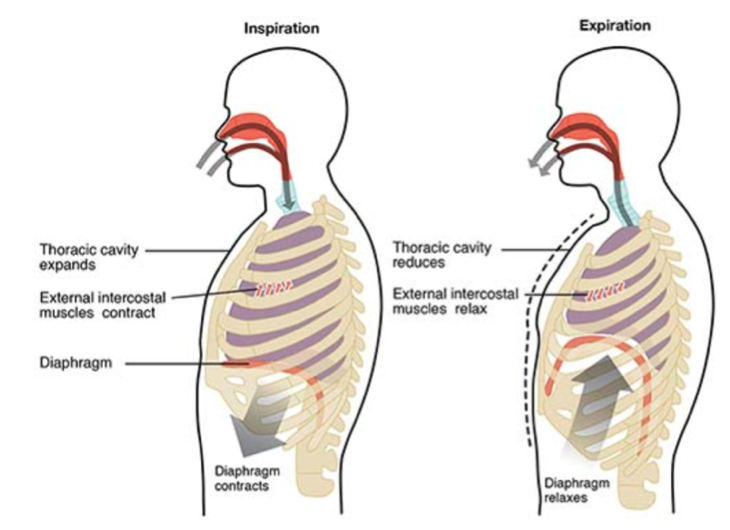
http://www.meadowheadphysiotherapy.co.uk/blog/back-pain-core-muscles-and-breathing/
If the physical demand for more stability presents itself, the diaphragm can be accessed for its second function. It will need assistance from several other core muscles to create greater intra-abdominal pressure (IAP). As mentioned, this pressure can be created with or without inspiration. The maneuver used to create this pressure involves expansion of the stomach, low back, and lower sides/ribcage while simultaneously bearing down.
Intra-Abdominal Pressure Breathing
For the sake of this article, we will elaborate more on the combined functions for stability, also known as IAP breathing. You may be wondering how the creation of more pressure within the abdomen helps support the core and spine at all?
When the core muscles actively expand with the diaphragm engaged properly, we can use air filling the abdominal cavity to our advantage in creating greater pressure internally. While bracing the muscles in this expanded position, we can use the pressure internally to push outwardly into the spine. The muscles surrounding the spine on the outside of the abdominal cavity are bearing down in the opposite direction, effectively sandwiching the spine and pelvis in a more anatomically neutral and stable position.
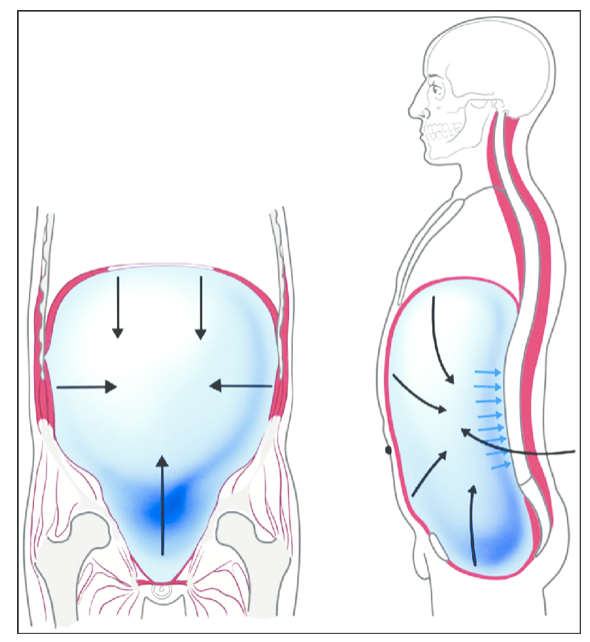
IAP Breath Practice/Tips
Now that you know more about benefits of breathing diaphragmatically and using intra-abdominal pressure for core bracing, it’s time to apply it! Try the practice below as a starting point.
PRACTICE:
Diaphragmatic breathing
- Lay down on your back in a comfortable position
- Place one hand on your stomach and one hand on your chest
- Breath through the nose, start to notice the breath
- Focus your attention on breathing deep into the stomach, filling the waist line with air 360 degrees around into the side and low back
- Let the breath do the work initially, on the breath in feel the stomach hand rise, feel the sides and lower ribcage expand laterally, feel the low back pressing into the floor, stop the breath in keeping the chest hand from rising
- As you breath out, let the stomach fall back in
- Once you have felt this breathing pattern for a couple minutes, transition into a more active expansion of the lower core using the IAP breathing
IAP breathing
- Repeat the same steps as above
- However, this time as you breath in, actively expand the stomach, lower sides and lower back outward as if filling a balloon
- Stop the breath before the chest hand rises
- Keep the expansion of your core muscles active even as you breath out and bear down
- Practice maintaining the expansion of your core muscles as you cycle breaths in and out
- Understand breathing in and out becomes more difficult when actively expanding and bracing
- If you feel short of breath, light-headed, dizzy, then STOP, RELAX, take some normal breaths
For a video demonstration, CLICK HERE: https://www.youtube.com/watch?v=KR-ZFC7IRr4
Spend some time practicing this exercise laying on the back or stomach initially. After getting more comfortable, bring the exercise to seated position and eventually standing position as well. This can, and should, be applied to core stability exercises and lifting heavy loads. Understand, the maneuver will be more difficult in standing and loaded positions. With some focused practice initially and in gradually progressive positions, the goal is this becomes easier and more autonomic over time.
Resources
http://www.hanslindgren.com/blog/diaphragm-control-switch/
http://www.hanslindgren.com/blog/iap-diagram-core-stabilization/
https://mikereinold.com/core-stability-from-the-inside-out/